




Venustus Angelfish Centropyge venustus
Notify Me When In Stock
Venustus Angelfish – Centropyge venusta Care Guide
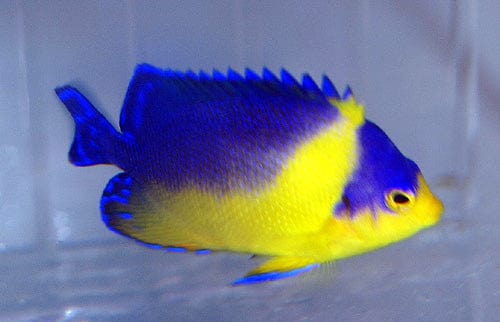
The Venustus Angelfish (Centropyge venusta) is a rare and highly distinctive dwarf marine angelfish prized for its deep blue to purple upper body, brilliant yellow lower body and tail, and contrasting facial pattern. Also known as the Purplemask Angelfish, this species has a refined appearance that differs dramatically from the more common orange and red dwarf angelfish.
Venustus Angelfish are naturally secretive and spend considerable time around caves, ledges, and shaded reef structure. Their shy behavior and occasionally challenging feeding response make them best suited for experienced aquarists with mature marine systems.
Browse additional saltwater angelfish to compare species, sizes, coloration, and aquarium requirements.
Venustus Angelfish Appearance
Centropyge venusta displays a striking two-tone pattern. The upper body and head are typically deep blue to violet or purple-blue, while the lower body, belly, and tail are bright yellow.
The face may show a bold blue-purple mask extending through the eye and head, creating the distinctive appearance behind the Purplemask Angelfish common name.
Individual specimens can vary slightly in the balance between blue, purple, and yellow coloration.
Behavior and Temperament
The Venustus Angelfish is generally considered peaceful to semi-aggressive. It is typically more reserved and secretive than many other dwarf angelfish, especially during acclimation.
Newly introduced specimens may spend much of their time inside caves, beneath ledges, or in shaded sections of rockwork. This behavior reflects the species' natural preference for protected reef structure.
Once established, individuals may defend preferred caves or territories from other dwarf angelfish and similarly shaped fish.
Natural Habitat and Distribution
Centropyge venusta is native to the western Pacific, with a natural range extending from Japan south toward the northern Philippines.
The species is associated with steep outer reef slopes, caves, ledges, and other shaded reef structures. In the wild, it is frequently observed remaining close to shelter and may even swim upside down along cave ceilings and overhangs.
A mature aquarium with extensive caves and shaded retreats is therefore especially important for helping this species feel secure.
Venustus Angelfish Aquarium Setup
A mature aquarium of approximately 70 gallons or larger is recommended for long-term care. Although the Venustus Angelfish remains relatively small, the quality and complexity of the habitat are especially important.
Provide abundant live rock arranged into caves, overhangs, narrow crevices, and shaded retreat areas. Open swimming room should also be available once the fish becomes comfortable exploring the aquarium.
Stable salinity, mature biological filtration, excellent water quality, and a well-established system are strongly recommended.
Venustus Angelfish Diet and Feeding
Feeding can be one of the more challenging aspects of Venustus Angelfish care. Newly acquired specimens may initially be reluctant to leave shelter or accept prepared foods.
Recommended foods include:
- Sponge-based dwarf angelfish preparations
- Mysis shrimp
- Enriched brine shrimp
- Finely chopped clam and marine seafood
- Frozen marine omnivore blends
- Spirulina and marine algae preparations
- High-quality marine pellets once accepted
- Small meaty foods offered near caves and shaded areas
Offer small portions multiple times throughout the day when possible. During acclimation, placing food close to the fish's preferred cave or ledge may encourage feeding.
Monitor body condition carefully. A specimen that is not eating consistently should be addressed quickly.
Is the Venustus Angelfish Reef Safe?
The Venustus Angelfish is best considered reef compatible with caution. Some individuals coexist successfully with corals, while others may nip at soft corals, fleshy stony corals, clam mantles, ornamental sponges, and other sessile invertebrates.
Individual behavior varies, so complete reef safety cannot be guaranteed.
Suitable Tankmates for Venustus Angelfish
Because this species can be shy, peaceful to moderately assertive tankmates are generally preferred. Suitable companions may include:
- Clownfish
- Cardinalfish
- Gobies
- Blennies
- Fairy and flasher wrasses
- Anthias
- Peaceful tangs in appropriately sized aquariums
- Other non-aggressive marine fish
Avoid overly aggressive tankmates that may prevent the Venustus Angelfish from leaving its shelter or competing successfully for food.
Use caution with additional dwarf angelfish unless the aquarium provides substantial space and multiple separate territories.
Venustus Angelfish Care Facts
- Care Level: Advanced
- Temperament: Peaceful to Semi-Aggressive
- Diet: Omnivore
- Reef Compatible: With Caution
- Minimum Tank Size: 70 gallons
- Maximum Size: Approximately 4.5–4.75 inches
- Natural Range: Western Pacific
- Native Region: Japan to Northern Philippines
- Preferred Habitat: Caves, ledges, and steep reef slopes
- Family: Pomacanthidae
- Scientific Name: Centropyge venusta
- Common Names: Venustus Angelfish, Purplemask Angelfish
Recommended Water Parameters
- Temperature: 72–78°F
- Specific Gravity: 1.020–1.025
- pH: 8.1–8.4
- Alkalinity: 8–12 dKH
Approximate Purchase Size
- Small: Approximately 1.5"–2.25"
- Medium: Approximately 2.25"–3.25"
- Large: Approximately 3.25"–4"
Actual purchase size and blue-purple to yellow color balance may vary between individual specimens.
Why Choose a Venustus Angelfish?
The Venustus Angelfish offers a rare combination of deep purple-blue and brilliant yellow coloration in a compact dwarf angelfish. Its secretive cave-oriented behavior and unusual pattern give it a very different presence from more commonly available Centropyge species.
For experienced aquarists willing to provide a mature aquarium, extensive shelter, and careful feeding attention, Centropyge venusta can become an exceptional centerpiece fish.
Explore more angelfish for saltwater aquariums to compare additional species, sizes, coloration, and care requirements.
Frequently Asked Questions About Venustus Angelfish
What is the correct scientific name for the Venustus Angelfish?
The currently accepted scientific name is Centropyge venusta. The spelling Centropyge venustus has also appeared historically but is treated as a synonym.
How large does a Venustus Angelfish get?
The Venustus Angelfish reaches approximately 4.5 to 4.75 inches in length.
What size aquarium does a Venustus Angelfish need?
A mature aquarium of approximately 70 gallons or larger is recommended, with numerous caves, ledges, shaded retreats, and established rockwork.
Is the Venustus Angelfish difficult to keep?
It is best considered an advanced species because newly acquired specimens can be shy and may require extra effort to establish consistent feeding.
What should I feed a Venustus Angelfish?
Offer sponge-based dwarf angelfish foods, mysis shrimp, enriched brine shrimp, clam, marine omnivore blends, algae-based foods, and other high-quality marine preparations.
Is the Venustus Angelfish reef safe?
It is considered reef compatible with caution. Individual specimens may occasionally nip at corals, clam mantles, ornamental sponges, or other sessile invertebrates.
Why does my Venustus Angelfish hide?
This species naturally inhabits caves and ledges and tends to remain close to shelter. Hiding is especially common during acclimation and is normal as long as the fish is feeding and maintaining body condition.
Where is the Venustus Angelfish found naturally?
Centropyge venusta occurs in the western Pacific from Japan to the northern Philippines and is strongly associated with caves, ledges, and steep reef slopes.
Coral Culture Check-In


- Additional Information
- Reviews

Reviews
There are no reviews yet.