





Singapore Angelfish - Chaetodontoplus mesoleucus
Notify Me When In Stock
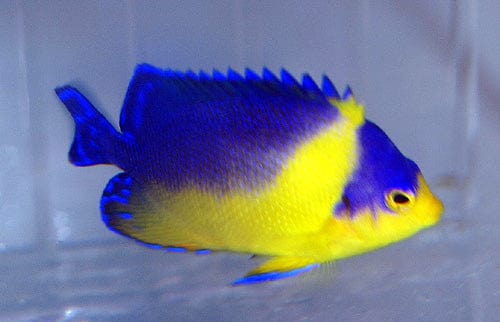


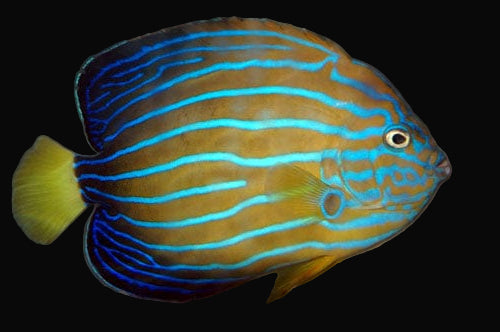
- Description
- Additional Information
- Reviews
Singapore Angelfish – Chaetodontoplus mesoleucus Care Guide
The Singapore Angelfish (Chaetodontoplus mesoleucus) is a distinctive marine angelfish recognized by its pale cream to whitish body, bold dark vertical banding, bright yellow fins, and subtle blue facial accents. Its clean, high-contrast pattern gives the species a very different appearance from many of the more heavily patterned large angelfish.
Also known as the Vermiculated Angelfish, this species is found throughout parts of the Indo-West Pacific and is commonly associated with coral-rich and rocky reef environments.
Browse additional saltwater angelfish to compare species, sizes, coloration, and aquarium requirements.
Singapore Angelfish Appearance
Chaetodontoplus mesoleucus typically displays a pale cream to whitish body with a broad dark vertical band extending through the midsection. Additional dark markings may appear around the head and rear body, creating a sharply divided pattern.
The dorsal, anal, and caudal fins often show strong yellow coloration, while blue accents may appear around the lips, face, and fin edges.
Individual specimens can vary slightly in the width and intensity of the dark banding and yellow coloration.
Behavior and Temperament
The Singapore Angelfish is generally considered semi-aggressive. Established individuals may defend preferred caves, feeding areas, and sections of rockwork from other angelfish or similarly shaped fish.
Provide substantial rockwork with caves, arches, overhangs, and visual barriers so the fish can establish a secure territory while still having open swimming room.
Keeping a single angelfish of this type is generally the simplest approach unless the aquarium is large enough to support multiple territories.
Natural Habitat and Distribution
Chaetodontoplus mesoleucus occurs throughout parts of the Indo-West Pacific and is associated with coral reefs, rocky reef slopes, lagoons, and other structured marine environments.
The species spends much of its time around caves, ledges, and reef structure where it can graze and quickly retreat when disturbed.
A mature aquarium with extensive rockwork and established grazing surfaces helps recreate the type of habitat this species naturally uses.
Singapore Angelfish Aquarium Setup
A mature aquarium of approximately 100 gallons or larger is recommended for long-term care. Although the Singapore Angelfish is not among the largest marine angelfish, it still benefits from generous swimming space and substantial rock structure.
Provide caves, overhangs, arches, and shaded retreat areas while maintaining open swimming lanes throughout the aquarium.
Stable salinity, mature biological filtration, good oxygenation, and consistent water quality are especially important during acclimation.
Singapore Angelfish Diet and Feeding
The Singapore Angelfish is an omnivore that naturally consumes a variety of reef-associated foods, including sponge material, algae, and small marine invertebrates.
Recommended foods include:
- Sponge-based marine angelfish preparations
- Spirulina and marine algae
- Marine algae sheets or nori
- Mysis shrimp
- Enriched brine shrimp
- Finely chopped clam and marine seafood
- Frozen marine omnivore blends
- High-quality marine pellets
Feed two to three smaller meals throughout the day when possible. Mature live rock can also provide supplemental grazing opportunities.
Is the Singapore Angelfish Reef Safe?
The Singapore Angelfish is generally not considered reliably reef safe. Individual specimens may nip at soft corals, fleshy stony corals, clam mantles, ornamental sponges, and other sessile invertebrates.
Some specimens may coexist with selected corals for extended periods, but long-term reef compatibility cannot be guaranteed.
Fish-only and fish-only-with-live-rock aquariums provide the most predictable environment.
Suitable Tankmates for Singapore Angelfish
The Singapore Angelfish can coexist with many peaceful to moderately assertive marine fish when adequate space is available. Suitable tankmates may include:
- Clownfish
- Wrasses
- Rabbitfish
- Tangs and surgeonfish
- Hawkfish
- Cardinalfish
- Gobies
- Other moderately assertive marine fish
Use caution with other angelfish, particularly species with similar body shapes or feeding territories.
Singapore Angelfish Care Facts
- Care Level: Moderate
- Temperament: Semi-Aggressive
- Diet: Omnivore / Sponge Feeder
- Reef Compatible: No / With Significant Caution
- Minimum Tank Size: 100 gallons
- Maximum Size: Approximately 7 inches
- Natural Range: Indo-West Pacific
- Family: Pomacanthidae
- Scientific Name: Chaetodontoplus mesoleucus
- Common Names: Singapore Angelfish, Vermiculated Angelfish
Recommended Water Parameters
- Temperature: 74–80°F
- Specific Gravity: 1.020–1.025
- pH: 8.1–8.4
- Alkalinity: 8–12 dKH
Approximate Purchase Size
- Small: Approximately 2"–3"
- Medium: Approximately 3"–4.5"
- Large: Approximately 4.5"–6"
Actual purchase size, banding, and yellow coloration may vary between individual specimens.
Why Choose a Singapore Angelfish?
The Singapore Angelfish offers a clean, high-contrast appearance with its pale body, dark vertical banding, and bright yellow fins. Its pattern is distinct from many other large marine angelfish and gives it a refined, understated look.
For aquarists with a mature saltwater aquarium, Chaetodontoplus mesoleucus can become an attractive centerpiece fish when provided with substantial rockwork, stable conditions, and a varied diet.
Explore more angelfish for saltwater aquariums to compare additional species, sizes, coloration, and care requirements.
Frequently Asked Questions About Singapore Angelfish
How large does a Singapore Angelfish get?
The Singapore Angelfish can reach approximately 7 inches in total length.
What size aquarium does a Singapore Angelfish need?
A mature aquarium of approximately 100 gallons or larger is recommended, with abundant rockwork, caves, and open swimming space.
Is the Singapore Angelfish reef safe?
Not reliably. Individual specimens may nip at corals, clam mantles, ornamental sponges, and other sessile invertebrates.
What should I feed a Singapore Angelfish?
Offer a varied diet containing sponge-based marine angelfish foods, marine algae, Spirulina, mysis shrimp, enriched brine shrimp, clam, and other high-quality marine preparations.
Is the Singapore Angelfish aggressive?
The species is generally semi-aggressive and may become territorial toward other angelfish or similarly shaped fish after becoming established.
What does a Singapore Angelfish look like?
The species typically has a pale cream to white body with broad dark vertical banding, yellow fins, and subtle blue accents around the face and fin edges.
Where is the Singapore Angelfish found naturally?
Chaetodontoplus mesoleucus occurs throughout parts of the Indo-West Pacific and inhabits coral-rich and rocky reef environments.

Reviews
There are no reviews yet.