



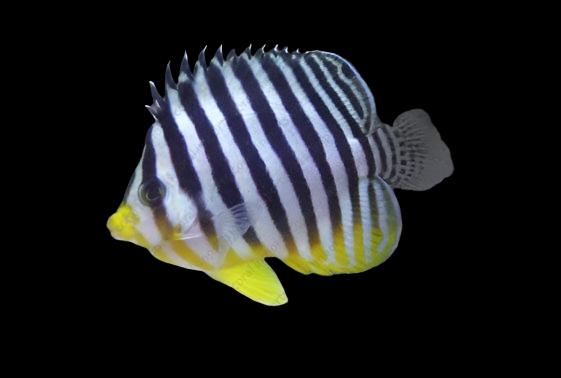

Multi-Barred Angelfish – Centropyge multifasciata
Notify Me When In Stock
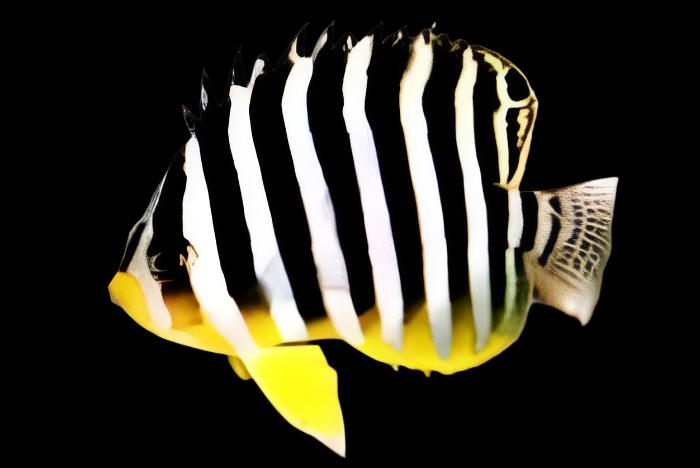
The Multibar Angel, also known as the Many-Banded Angelfish or Multibarred Angelfish, features alternating vertical bands of black and yellow framed by white margins. Its caudal fin is white to pale yellow with tiny black speckles. Juveniles can be identified by a distinct blue ocellus (eyespot) positioned on the posterior edge of the dorsal fin.

- Description
- Additional Information
- Reviews
Multi-Barred Angelfish – Centropyge multifasciata Care Guide
The Multi-Barred Angelfish (Centropyge multifasciata) is an uncommon and highly distinctive dwarf marine angelfish known for its creamy-white body covered with numerous dark vertical bars. Yellow accents between the darker bands and a contrasting dark spot on the dorsal fin give this species a detailed pattern unlike most other dwarf angelfish.
Also known as the Multibar Angelfish, Multibarred Angelfish, or Barred Angelfish, this species naturally inhabits caves, ledges, and crevices along deeper reef slopes. Its secretive behavior and sometimes challenging feeding response make it best suited for experienced marine aquarists.
Browse additional saltwater angelfish to compare species, sizes, coloration, and aquarium requirements.
Multi-Barred Angelfish Appearance
Centropyge multifasciata has a pale white to cream body crossed by approximately eight prominent brown to dark vertical bars. These bands continue into portions of the dorsal and anal fins, creating a strongly patterned appearance from head to tail.
Yellow to orange-yellow coloration appears between portions of the darker bars, particularly toward the lower body, while a dark spot is present toward the rear portion of the dorsal fin.
The first dark band passes through the eye, helping create the masked appearance commonly seen in this species.
Behavior and Temperament
The Multi-Barred Angelfish is generally considered peaceful to semi-aggressive. It is typically more secretive than many other dwarf angelfish and may remain close to caves and shaded rockwork, particularly during acclimation.
In its natural habitat, this species rarely ventures far from an escape crevice. A heavily structured aquarium with numerous caves, ledges, and narrow retreats is therefore especially important.
Once established, individuals may defend preferred hiding areas from other dwarf angelfish or similarly shaped fish.
Natural Habitat and Distribution
Centropyge multifasciata has a broad Indo-Pacific distribution extending from the Cocos-Keeling region east toward the Society Islands, north to the Yaeyama Islands, and south to the Great Barrier Reef.
The species inhabits steep outer reef slopes, ledges, caves, and crevices and is most commonly encountered in deeper reef environments. It may also occur in clear lagoon reefs.
Because it naturally spends considerable time close to shelter, extensive rockwork is one of the most important elements of a successful aquarium setup.
Multi-Barred Angelfish Aquarium Setup
A mature aquarium of approximately 70 gallons or larger is recommended. While the Multi-Barred Angelfish remains relatively small, it benefits greatly from a stable, mature system with extensive rockwork and established natural grazing surfaces.
Create numerous caves, shaded overhangs, ledges, and narrow crevices while maintaining open areas between structures for swimming.
Dimmer sheltered areas can help newly introduced specimens feel secure and begin exploring the aquarium more confidently.
Multi-Barred Angelfish Diet and Feeding
The Multi-Barred Angelfish can be a challenging feeder, particularly when first introduced. This is one of the most important considerations when deciding whether the species is appropriate for a particular aquarium.
A mature aquarium with established live rock provides natural grazing opportunities while the fish becomes accustomed to prepared foods.
Recommended foods include:
- Sponge-based marine angelfish preparations
- Mysis shrimp
- Enriched brine shrimp
- Finely chopped clam and other marine seafood
- Frozen marine omnivore blends
- Spirulina and marine algae preparations
- High-quality marine pellets once accepted
- Small meaty foods offered near caves and sheltered areas
Offer small portions several times throughout the day when possible. During acclimation, placing food near the fish's preferred cave or retreat may encourage feeding.
Carefully monitor body condition. A specimen that is not feeding consistently should be addressed quickly rather than assuming it will eventually begin eating on its own.
Is the Multi-Barred Angelfish Reef Safe?
The Multi-Barred Angelfish is generally considered reef compatible with caution. Some individuals coexist successfully with corals, while others may investigate or nip at soft corals, fleshy stony corals, clam mantles, ornamental sponges, and other sessile invertebrates.
Individual behavior varies, so complete coral safety cannot be guaranteed.
Suitable Tankmates for Multi-Barred Angelfish
Because this species can be shy during acclimation, peaceful to moderately assertive tankmates are generally preferred. Suitable companions may include:
- Clownfish
- Cardinalfish
- Gobies
- Blennies
- Fairy and flasher wrasses
- Anthias
- Peaceful tangs in appropriately sized aquariums
- Other non-aggressive marine fish
Avoid overly aggressive tankmates that may prevent the Multi-Barred Angelfish from leaving its shelter or competing successfully for food.
Use caution when combining it with other dwarf angelfish unless the aquarium provides substantial space and separate territories.
Multi-Barred Angelfish Care Facts
- Care Level: Advanced
- Temperament: Peaceful to Semi-Aggressive
- Diet: Omnivore
- Reef Compatible: With Caution
- Minimum Tank Size: 70 gallons
- Maximum Size: Approximately 4.5–4.75 inches
- Natural Range: Indo-Pacific
- Preferred Habitat: Caves, ledges, crevices, and deeper reef slopes
- Family: Pomacanthidae
- Scientific Name: Centropyge multifasciata
- Common Names: Multi-Barred Angelfish, Multibar Angelfish, Multibarred Angelfish, Barred Angelfish
Recommended Water Parameters
- Temperature: 74–80°F
- Specific Gravity: 1.020–1.025
- pH: 8.1–8.4
- Alkalinity: 8–12 dKH
Approximate Purchase Size
- Small: Approximately 1.5"–2.25"
- Medium: Approximately 2.25"–3.25"
- Large: Approximately 3.25"–4"
Actual purchase size, coloration, and bar pattern may vary between individual specimens.
Why Choose a Multi-Barred Angelfish?
The Multi-Barred Angelfish offers a pattern rarely seen among dwarf marine angelfish. Its pale body, repeated dark vertical bars, subtle yellow accents, and secretive cave-oriented behavior give it a very different appearance and personality from more commonly available Centropyge species.
For experienced aquarists willing to provide a mature aquarium and carefully monitor feeding, Centropyge multifasciata can become an exceptional and unusual centerpiece fish.
Explore more angelfish for saltwater aquariums to compare additional species, sizes, coloration, and care requirements.
Frequently Asked Questions About Multi-Barred Angelfish
How large does a Multi-Barred Angelfish get?
The Multi-Barred Angelfish reaches approximately 4.5 to 4.75 inches in total length.
What size aquarium does a Multi-Barred Angelfish need?
A mature aquarium of approximately 70 gallons or larger is recommended, particularly one containing abundant caves, crevices, mature live rock, and natural grazing surfaces.
Is the Multi-Barred Angelfish difficult to keep?
It is best considered an advanced species because newly acquired specimens can be secretive and reluctant to accept prepared aquarium foods. A mature aquarium and careful observation of feeding behavior are important.
What should I feed a Multi-Barred Angelfish?
Offer a varied diet containing sponge-based angelfish foods, mysis shrimp, enriched brine shrimp, clam, marine omnivore blends, Spirulina, and other quality marine preparations. Small frequent feedings are recommended.
Is the Multi-Barred Angelfish reef safe?
It is considered reef compatible with caution. Some individuals may nip at corals, clam mantles, ornamental sponges, or other sessile invertebrates.
Why does my Multi-Barred Angelfish hide?
This species naturally inhabits caves, ledges, and crevices and tends to remain close to shelter. Hiding during acclimation is therefore normal, although the fish should still be monitored carefully to ensure it is eating.
Where is the Multi-Barred Angelfish found naturally?
Centropyge multifasciata occurs throughout a broad portion of the Indo-Pacific and is commonly associated with deeper reef slopes, caves, ledges, and crevices.
Can Multi-Barred Angelfish be kept in pairs?
The species naturally occurs as pairs or small groups, but maintaining more than one specimen in captivity requires adequate aquarium space, multiple secure territories, and careful observation for aggression.

Reviews
There are no reviews yet.