


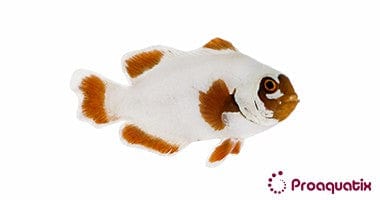
Maroon Clownfish Gold Nugget Captive Bred Premnas biaculeatus
- Description
- Additional Information
- Reviews
Maroon Clown Gold Nugget Captive Bred Percula Clownfish with Rare White Body Pattern
The Maroon Clown Gold Nugget Captive Bred Percula Clownfish brings a completely different look compared to traditional maroon varieties. Instead of the deep red body, this variation develops a clean white base with a rich orange-red face and matching fins. That contrast creates a bold, almost inverted appearance that immediately stands out in reef tanks.
Because this specimen is captive bred, it adjusts quickly to aquarium life. It eats prepared foods without hesitation and handles standard reef conditions with consistent reliability. This makes it a strong option for aquarists looking for something visually unique without sacrificing stability.
What Makes the Maroon Clownfish Gold Nugget Variation Different
Most maroon clownfish carry a dark maroon body with striping. This version flips that expectation.
- Bright white body replaces the typical maroon coloration
- Orange to red facial mask adds sharp contrast
- Orange fins tie the entire look together
- Patterning continues to develop as the fish matures
The result feels more refined and high-contrast compared to standard maroon clownfish.
Temperament and Tank Behavior
This fish carries the same personality maroon clowns are known for—confident, territorial, and not easily pushed around.
- Can become aggressive toward other clownfish
- Best kept solo or as a confirmed pair
- Will establish and defend its space in the tank
- Interacts heavily with its chosen hosting area
Once settled, it becomes one of the most noticeable fish in the system, both visually and behaviorally.
Hosting and Tank Setup
A 30-gallon or larger aquarium provides enough room for proper territory development. Adding a host anemone enhances natural behavior.
- Common host: Bubble Tip Anemone (Entacmaea quadricolor)
- Will often adopt the anemone as its central territory
- Rock structure helps define boundaries and reduce stress
While an anemone is not required, it does bring out more natural movement and interaction.
Feeding and Care
Feeding is straightforward, especially with captive-bred specimens.
- Accepts frozen mysis shrimp and brine shrimp
- Eats high-quality pellet and flake foods
- Benefits from a mix of meaty and plant-based foods
Consistent feeding keeps coloration strong and supports long-term health.
Handling Tips
Avoid using nets when moving this species. The cheek spines can easily get caught and cause damage. A specimen container works much better and reduces stress.
Key Care Guidelines
- Care Level: Easy
- Temperament: Aggressive
- Diet: Omnivore
- Reef Compatible: Yes
- Minimum Recommended Tank Size: 30 Gallons
- Max Size: 6 inches
- Temperature: 72–78°F
- Specific Gravity: 1.020–1.025
- dKH: 8–12
Average Purchase Size
- Tiny: Under 0.75"
- Small: 0.75" to 1.5"
- Small Medium: 1.5" to 2.25"
- Medium: 2.25" to 3"
- Medium Large: 3" to 3.75"
- Large: 3.75" to 4.75"
- XL: 4.75" to 6"
Reviews
There are no reviews yet.